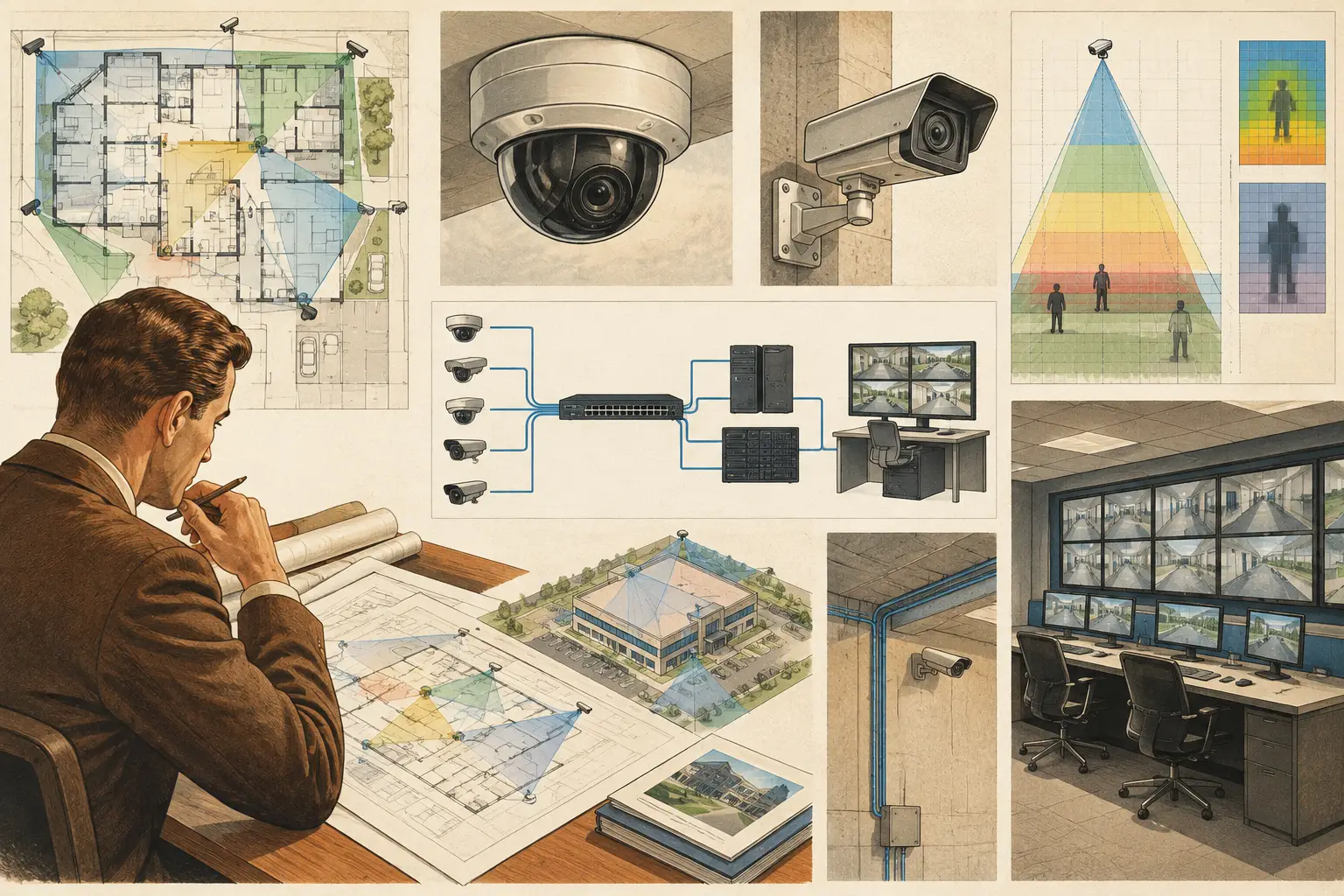
A commercial CCTV tender documentation guide is not a camera schedule with a few marked-up floor plans. It is the controlled record that allows consultants, bidders, installers, ICT teams, and project owners to interpret the intended system in the same way. If the documents do not connect operational objectives to field of view, pixel density, physical constraints, and network requirements, the tender can produce pricing that appears comparable but is based on fundamentally different scopes.
For commercial projects, ambiguity usually emerges at interfaces: cameras that cannot achieve the stated identification objective at the target distance, coverage cones drawn through walls, omitted containment, uncertain recording retention, or network equipment left between security and ICT packages. The documentation should make those decisions visible early, while there is still time to review them.
Start With a Defined Security Objective
Tender drawings should begin with what each area needs the CCTV system to achieve. “Monitor lobby” is too broad to specify a meaningful camera solution. A better requirement defines the operational task, the observation zone, and the applicable conditions. For example, a reception overview may require monitoring of circulation and queue activity, while an entrance point may require a face-identification objective at a defined approach path.
DORI provides a useful common language for this discussion: detection, observation, recognition, and identification. The required level should be assigned to the relevant zone rather than casually applied to an entire camera view. A panoramic camera may provide useful detection across a parking area while a separate camera is needed for recognition or identification at the vehicle entrance or pedestrian gate.
Where pixel density is used, state the required PPM value, the measured target plane, and the intended purpose. A calculated result is a design output based on the specified camera, focal length, sensor size, mounting height, tilt, and geometry. It is not, by itself, proof of real-world performance under every lighting condition, scene dynamic, compression setting, or installation tolerance.
Build Tender Documentation From a Coordinated Model
The most defensible documentation is generated from a coordinated design process, not assembled from disconnected files near bid issue. Import and calibrate the latest architectural drawing first. Scale calibration matters because a small error in plan scale affects target distances, field-of-view dimensions, camera spacing, and pixel-density calculations.
Then model or review the geometry that affects visibility. Walls, partitions, columns, doors, ceilings, racking, and major external structures can create occlusion. A camera cone that crosses a wall on a two-dimensional drawing may look acceptable but has little engineering value. The tender package should distinguish between apparent coverage and visible coverage after physical obstructions are considered.
For each proposed camera, record the mounting location, mounting height, direction, tilt, focal length, sensor size, resolution, and relevant lens configuration. This allows a reviewer to understand why a particular field of view has been selected and whether it supports the stated DORI objective. It also makes revisions traceable when architecture changes or a client requests a different coverage priority.
CCTV Design Tool Online can support this workflow by retaining calibrated drawings, camera parameters, physical geometry, coverage analysis, and report outputs in one browser-based design workspace. The resulting documentation still requires review by appropriately qualified project professionals, particularly where project-specific requirements or authority submissions apply.
What the Commercial CCTV Tender Package Should Include
A tender should give bidders enough information to price and deliver a technically comparable solution, while identifying items that remain subject to survey, coordination, or approval. The right level of detail depends on procurement route and project stage, but the following deliverables usually form the core package:
- A basis-of-design narrative defining the protected areas, operational scenarios, image-use objectives, assumptions, exclusions, and coordination boundaries.
- Calibrated floor plans and site plans showing camera IDs, viewing direction, field of view, coverage zones, key target areas, and known blind spots or coverage overlap.
- A camera schedule listing the required technical parameters and installation information for each camera location.
- Coverage and DORI or pixel-density reports showing how the specified objective has been assessed at critical points.
- A system architecture drawing that identifies camera networks, PoE switching, uplinks, recording platforms, operator workstations, storage, and integration interfaces.
- A bill of quantities or pricing schedule that separates equipment, mounting accessories, containment, cabling, testing, commissioning, training, and documentation.
- Tender notes covering site survey obligations, drawing coordination, labeling, testing records, commissioning deliverables, and as-built documentation.
This is not a requirement to overprescribe every component. Brand-agnostic specifications often improve competition when they define measurable technical performance rather than naming a manufacturer. However, a performance-based specification must be precise enough to prevent substitutions that meet a headline resolution requirement but materially change sensor size, low-light behavior, lens suitability, bitrate demand, or integration capability.
Make Camera Schedules Verifiable
The camera schedule is often treated as an administrative list. It should instead function as a verification tool. Each ID should match the plans, network diagram, quantity schedule, and final commissioning records. If a camera is added, moved, or deleted, every affected document should be revised together.
Include fields that support both procurement and installation: location, area served, camera form factor, mounting type, mounting height, target operational objective, resolution, sensor size where relevant, focal length or varifocal range, field-of-view direction, and environmental or housing requirements. If the project requires analytics, state the intended use case and validation requirements without implying that analytics will be accurate in every scene.
Avoid generic wording such as “camera to cover area fully.” Commercial spaces contain occlusion, changing furniture, open doors, delivery vehicles, and people. State the target zones and acceptable limitations. This gives bidders a defensible basis for raising constraints before installation rather than after a coverage dispute.
Coordinate CCTV With the Network and Building Design
A camera plan cannot be tendered in isolation from its network topology. Each camera affects PoE loading, switch-port count, cable pathways, cabinet space, uplink capacity, recording bandwidth, and storage. The tender should identify the intended responsibility split between security and ICT disciplines, especially where core switching, VLANs, cybersecurity policies, or virtualized recording environments sit outside the CCTV contractor’s scope.
At minimum, document camera counts by network location, proposed cabinet or telecom room locations, PoE assumptions, uplink paths, recording destinations, and interfaces requiring confirmation. Bandwidth and storage calculations should state their inputs, including resolution, frame rate, codec, scene activity assumptions, retention target, and recording mode. Those calculations are planning values, not a substitute for final configuration and manufacturer verification.
Physical coordination deserves equal attention. Mounting positions may conflict with lighting, fire devices, signage, ceiling access panels, facade systems, or structural elements. Tender drawings should show intended locations clearly, while requiring bidders to verify access, containment routes, and installation conditions during survey and coordination.
Write Acceptance Criteria Before Bids Are Returned
A tender becomes easier to evaluate when its acceptance criteria are written before pricing is received. Require the successful bidder to submit a camera-by-camera compliance matrix against the schedule, including proposed model details and deviations. Request updated coverage evidence where an alternative camera, lens, mounting height, or location is proposed.
Commissioning requirements should be practical and observable. They may include confirmation of camera IDs, views, focus, image orientation, time synchronization, recording operation, alarm or integration tests where applicable, network labeling, and updated as-built drawings. For critical target areas, require verification that the installed view corresponds to the approved design intent. If site conditions require a change, document the reason, the revised geometry, and the impact on coverage.
Do not describe this as guaranteed compliance with any regulation or authority. Jurisdiction-specific obligations, privacy controls, retention rules, and authority expectations must be confirmed for the particular project by qualified professionals and the relevant authority.
Protect Comparability During Tender Evaluation
Lowest price is meaningful only when scope is comparable. Review bids against the design intent, not just the total number of cameras or megapixels offered. A bidder may reduce cost by changing focal length, omitting a mounting accessory, assuming existing network capacity, excluding containment, or replacing a specified coverage objective with a wider but lower-density overview.
Use a structured technical review that checks deviations, coverage reports, equipment compatibility, network assumptions, installation methodology, and commissioning deliverables. Clarifications should be issued consistently to all bidders where they change the interpretation of the tender. That preserves a fair procurement process and reduces late-stage arguments over what was included.
A well-prepared tender document does not eliminate site constraints or design change. It gives every party a shared, measurable starting point for resolving them. When camera placement, field of view, occlusion, DORI, network topology, and acceptance evidence are connected in the same documentation set, the project team can make better decisions before cables are pulled and ceilings are closed.