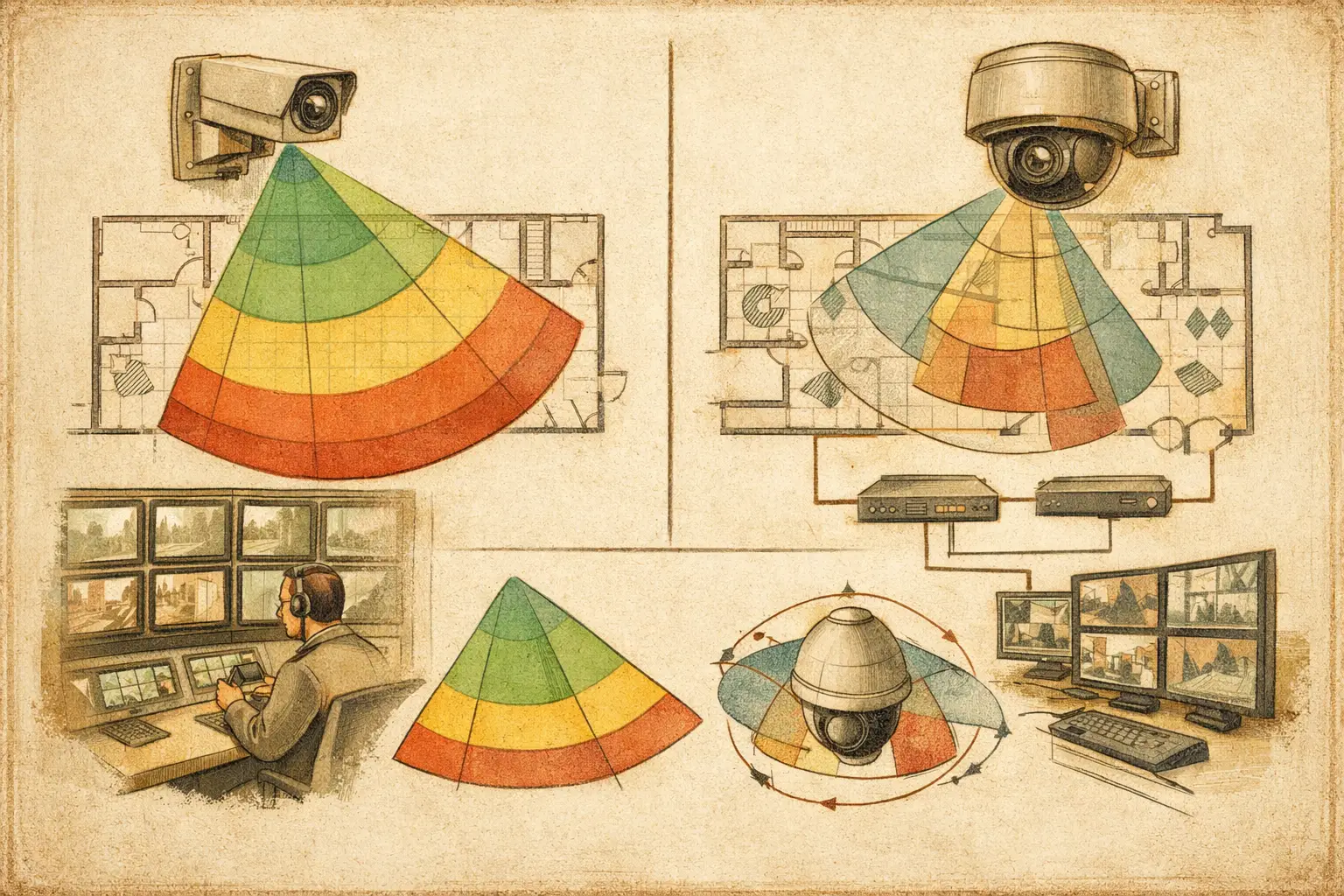
A PTZ camera can follow activity across a wide area, but its field of view exists only where it is pointing at that moment. A fixed camera records the same scene continuously, but cannot investigate beyond its defined view. That distinction is the foundation of a fixed versus PTZ decision, and it should be resolved through coverage requirements rather than camera count or visual preference.
For most projects, fixed and PTZ cameras are not interchangeable. They perform different roles in a security design: fixed cameras provide persistent evidential coverage of defined locations, while PTZ cameras provide operational flexibility and directed observation. A credible design identifies where each role adds value, then tests the geometry, pixel density, occlusion, and operating assumptions behind it.
Fixed versus PTZ: the core design difference
A fixed camera has a stable mounting position, direction, focal length, and field of view. Once commissioned, its image composition remains predictable unless the camera is physically adjusted. This makes it suitable for entrances, corridors, cash points, loading docks, gates, perimeter crossings, and other locations where continuous visibility matters.
A PTZ camera can pan, tilt, and zoom to observe multiple areas from one mounting location. It may use presets, tours, alarms, analytics triggers, or manual operator commands to move between scenes. Its value is strongest where trained operators need to investigate developing activity across a large, open, or changing environment, such as a parking area, campus road, public plaza, or industrial yard.
The key limitation is simple: while a PTZ is examining one target, it is not recording its highest-detail view of every other target outside the active frame. A PTZ positioned on a tour also creates time gaps at each preset. Those gaps may be acceptable for general situational awareness, but they must not be mistaken for continuous coverage.
Start with the required outcome, not the camera type
The correct choice begins with the required task at each scene. DORI principles are useful because they connect camera geometry to operational intent. A broad overview may support detection, while an access point may require observation, recognition, or identification at a specified target plane.
Pixel density, expressed as pixels per meter or PPM, should be evaluated at the relevant distance and across the relevant area. A wide fixed lens may show an entire lobby but provide insufficient PPM for recognition at the far doorway. A PTZ may achieve high pixel density when zoomed onto that doorway, but only while it is directed there.
This creates a common design pattern: use fixed cameras to establish the continuous baseline, then use PTZ cameras to extend an operator's ability to inspect events. The fixed cameras retain contextual evidence of who entered, where people moved, and what occurred while the PTZ was focused elsewhere.
Where fixed cameras are the stronger choice
Fixed cameras are usually the primary choice when the scene has a known risk point and the camera must continuously document it. Their stable framing supports incident review, camera-to-camera handoff, forensic search, and predictable scene illumination. It also makes the relationship between field of view and required pixel density easier to document and validate.
At an employee entrance, for example, a fixed camera can be designed around the approach path and face-capture zone. The focal length, sensor size, mounting height, tilt, and direction can be selected to place the target area within the required PPM range. A second fixed overview camera may record queuing, tailgating, or activity around the entrance without relying on a moving device.
Fixed cameras also simplify coverage coordination. Their fields of view can be plotted on a calibrated floor plan, checked against walls and openings, and compared for overlap. This helps reveal blind spots caused by partitions, racking, columns, landscape features, vehicles, or changes in elevation.
They are not automatically simple, however. A fixed camera with an unsuitable lens can create a broad but unusable image. Excessive mounting height can reduce face detail and produce unfavorable viewing angles. Backlight, glare, low-light conditions, compression settings, and scene motion will affect actual performance beyond calculated design results.
Where PTZ cameras add operational value
PTZ cameras are most useful when an operator benefits from selecting among multiple possible views. A single unit at a perimeter corner may observe a vehicle gate, fence line, open yard, and adjacent roadway. At a transport facility, it may help an operator verify an alarm location, follow a person through an open concourse, or inspect a developing crowd condition.
Optical zoom can provide a narrow field of view and higher pixel density on a remote target than a fixed overview camera could provide from the same location. This is valuable for directed assessment, provided the camera's optical specifications, lighting conditions, movement speed, and usable zoom range have been verified from the relevant manufacturer documentation.
PTZ placement still requires disciplined geometry. A camera may have nominal visibility over a large area yet lose sight lines behind building corners, canopies, trees, fencing, or tall vehicles. Its tilt limits, mounting height, and line of sight should be tested at meaningful target locations, not only from an elevated plan-view cone.
A PTZ should also be assigned a defined operational concept. Will it remain at a home preset? Run a timed guard tour? Move after a video analytics event? Be controlled from a security operations center? Each option changes the level of continuous coverage that can reasonably be claimed in the design documentation.
Do not treat a PTZ tour as fixed-camera coverage
A guard tour is often used to make one PTZ visit several zones. This may improve awareness, but it does not provide the same result as simultaneous fixed views. Dwell time, travel time, preset accuracy, zoom position, and scene priority all affect what is recorded at each location.
Consider a PTZ with four presets and a 20-second dwell at each. Even before accounting for movement between presets, each area is observed intermittently rather than continuously. If an event occurs shortly after the camera leaves a preset, the useful image may be missed or captured only by a wider fixed camera.
For this reason, critical doors, emergency exits, transaction points, and narrow choke points should generally have dedicated fixed coverage where continuous observation or a defined DORI outcome is required. A PTZ can complement that coverage, but it should not be the only assumed camera unless the project requirement explicitly accepts the operational limitation.
Design and infrastructure implications
The comparison extends beyond image coverage. Fixed cameras are generally easier to schedule because each device has one defined scene, lens configuration, and coverage purpose. PTZ cameras introduce additional considerations including control permissions, preset naming, home position, tour logic, alarm integration, maintenance access, and operator training.
Both camera types affect network topology, bandwidth estimates, PoE budgets, storage calculations, and switch-port allocation. A PTZ may use variable bitrate as scene detail and movement change. If it includes heaters, wipers, illuminators, or other accessories, its power demand can differ materially from a standard fixed camera. These inputs should be based on the selected product datasheet, not generic assumptions.
Documentation should make the distinction visible. A camera schedule can identify whether each device is fixed or PTZ, its mounting height, focal length or zoom range, direction, and intended coverage objective. Drawings should show fixed camera fields of view separately from PTZ home presets and preset extents. This prevents reviewers from reading a PTZ's full pan range as simultaneous evidential coverage.
A practical workflow for selecting both
Import and calibrate the floor plan or site drawing before placing cameras. Scale calibration is essential because a small error in drawing scale changes calculated distances, field-of-view width, target pixel density, and cable route estimates.
Next, define the coverage objectives by zone. Mark entrances, perimeter crossings, vehicle routes, high-value assets, public circulation areas, and operational watch areas. Identify where continuous coverage is required and where directed observation is sufficient.
Place fixed cameras first around critical target areas. Set mounting height, sensor size, focal length, tilt, and direction, then review DORI and PPM across the target plane. Account for walls and physical geometry so that camera cones do not pass through opaque structures or ignore likely occlusion.
Then add PTZ cameras for large-area oversight and investigation. Define each home position, preset, or tour as a separate operational view. Review what remains visible when the PTZ is away from its home preset, and add fixed coverage wherever an unattended gap is unacceptable.
A browser-based workspace such as CCTV Design Tool Online can help keep these decisions traceable by combining calibrated drawings, camera parameters, physical obstructions, coverage analysis, network planning, and technical reporting in one design record. Calculated outputs remain design guidance and should be reviewed against site conditions, selected equipment data, and project-specific requirements by qualified professionals.
The useful question is not whether fixed or PTZ cameras are better. It is whether every critical event still has the right level of continuous, usable coverage when the PTZ is looking somewhere else.