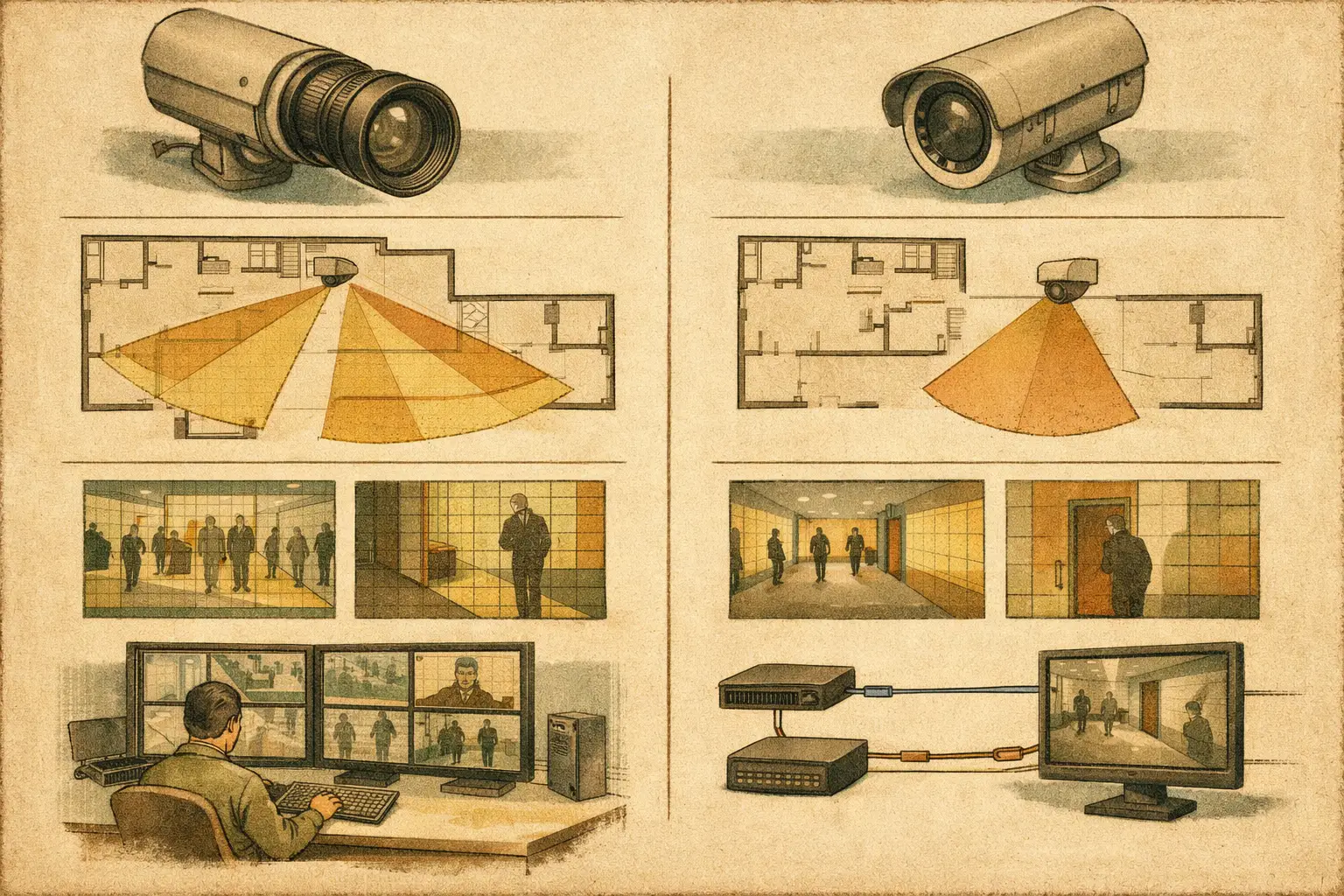
A camera shown with a wide coverage cone on a drawing may appear to cover an entrance, corridor, and reception desk. That does not mean it can deliver usable identification detail at each point. The choice between varifocal versus fixed camera lenses determines how much of the scene is captured, how pixels are distributed across that scene, and how much adjustment remains available during commissioning.
For a CCTV designer, lens selection is not a catalog preference. It is an optical decision that should follow the operational objective, required pixel density, sensor size, mounting position, obstructions, and expected changes to the site. A wide scene can improve situational awareness while reducing detail on distant subjects. A narrow scene can support stronger PPM at a target while creating blind spots around it. The correct choice depends on what the camera must prove, not simply what it can see.
Varifocal versus fixed camera lenses: the practical difference
A fixed lens has one focal length, such as 2.8 mm, 4 mm, 6 mm, or 12 mm. Its field of view is determined by that focal length and the camera sensor size. Once specified and installed, the framing is effectively fixed. A 2.8 mm lens may provide a wide view suitable for a small room or doorway context, while a 12 mm lens may concentrate pixels on a more distant gate or lane.
A varifocal lens provides a focal-length range, such as 2.8-12 mm or 8-32 mm. The installer can set a focal length within that range to tighten or widen the field of view. On motorized varifocal cameras, this adjustment can usually be made remotely through the camera interface or VMS, subject to the manufacturer’s available controls. Manual varifocal lenses require physical access for adjustment.
The distinction is straightforward, but its design consequences are not. A varifocal camera does not automatically provide better coverage than a fixed-lens camera. At any selected focal length, it still has one actual field of view. Its advantage is adaptability before, during, and sometimes after installation. A fixed lens does not automatically limit performance either. When the geometry and target distance are stable, a correctly selected fixed focal length can be precise, repeatable, and economical.
Start with the target, not the lens range
Lens selection should begin by defining the surveillance task at the relevant location. Are operators expected to monitor activity, observe behavior, recognize a familiar person, identify an unknown person, or read a vehicle plate under a defined operating scenario? These objectives require different levels of scene detail.
DORI provides a useful framework for discussing those needs: detection, observation, recognition, and identification. The associated pixel-density target, often expressed as pixels per meter or PPM, should be treated as a calculated design input rather than a promise of real-world evidential performance. Lighting, motion blur, compression, lens quality, focus accuracy, scene contrast, camera processing, and installation workmanship all affect the final image.
Once the required PPM is established, calculate the width of scene that can meet it at the target distance. Camera resolution contributes to the calculation, but resolution alone is not enough. A high-resolution camera pointed across a broad parking area may still spread its pixels too thinly for identification at the perimeter. Narrowing the field of view by increasing focal length can raise pixel density at that target, but it also excludes adjacent areas from the image.
Sensor size must remain part of the calculation. Two cameras with the same stated focal length can produce different fields of view when their sensor formats differ. Design records should therefore retain the selected camera parameters, focal length, sensor dimensions, resolution, mounting height, tilt, and direction. This makes the optical assumption traceable when the schedule, plan, or camera model changes.
When a fixed lens is the stronger engineering choice
Fixed lenses work well where camera geometry is known and unlikely to change. Typical examples include a compact office room, a controlled doorway, a reception point with a defined stand-off distance, or a corridor where the camera location and viewing direction have been confirmed against the architectural layout.
Their principal benefit is certainty. If a 4 mm lens has been calculated against the calibrated plan and verified to meet the intended coverage and PPM at the relevant target, the specified view is clear to the consultant, installer, and reviewer. There is less opportunity for a commissioning adjustment to unintentionally trade a required target for a more visually appealing wide shot.
Fixed lenses can also make a large deployment easier to standardize. A repeated room type with consistent dimensions may use the same camera specification and mounting detail throughout the site. That can simplify documentation, spare planning, installation instructions, and later review. This approach only remains valid if the actual rooms, mounting positions, and obstructions are genuinely consistent.
The trade-off is limited tolerance for site variation. A shifted ceiling feature, an unexpected duct, a changed partition, or a relocated door can make a fixed focal length less suitable than it appeared during design. The resulting issue may be a blocked view, excessive ceiling or floor in frame, insufficient PPM at a target, or an avoidable blind spot near the camera.
Where varifocal lenses add value
Varifocal lenses are particularly useful when the design needs to accommodate uncertainty without abandoning disciplined optical planning. In a loading area, compound entrance, retail floor, external path, or lobby with multiple possible mounting points, the final camera location may move slightly during coordination. A focal-length range can allow the installer to preserve the intended target framing after that move.
They are also valuable where the same camera family must serve different distances. A consultant may specify a varifocal range that covers several calculated focal-length requirements across a project, while documenting the intended setting for each camera position. This can reduce unnecessary model variation, although the actual selected focal length must still be recorded in the as-built information.
A motorized varifocal lens can help during commissioning and later operational changes. For example, a newly installed access-control pedestal, landscaping element, or tenant fit-out may alter the useful scene. Remote reframing may reduce disruption compared with replacing a fixed-lens camera. It does not remove the need to reassess coverage, occlusion, overlap, and pixel density after adjustment.
Varifocal flexibility has a risk: an adjustable camera can be left at an undocumented or poorly chosen focal length. A camera that is zoomed in to improve detail at one point may no longer provide the broader detection coverage assumed elsewhere in the design. The system can look acceptable in live view while failing the original operational intent. Commissioning should verify the final field of view against the approved design, not against a subjective impression of image quality.
Account for geometry before selecting optics
Lens decisions should be made on a calibrated drawing with physical geometry represented as accurately as the available information allows. A field-of-view cone that passes through walls, glazing treatment, racking, columns, or solid ceiling features is not a valid representation of usable coverage. Openings, wall heights where relevant, mounting elevations, and likely occlusions should be reviewed before choosing the final focal length.
Mounting height and tilt change the practical result as much as focal length in many indoor applications. A wide fixed lens mounted too high may devote substantial image area to the floor while leaving faces at the target distance with inadequate pixel density. A varifocal lens may recover some detail by narrowing the view, but excessive downward tilt can still compromise the intended facial angle or create occlusion behind shelving and fixtures.
Coverage overlap also needs a defined purpose. Overlap at entrances, cash handling positions, or transition zones can provide continuity and reduce single-camera dependency. Random overlap, however, can consume camera capacity without improving the DORI outcome. Review the combined layout for gaps, duplicated low-value views, and areas where a different mounting location would be more effective than a longer focal length.
A controlled workflow for lens selection
Import and calibrate the floor plan first. Then place proposed cameras using realistic mounting positions and directions, rather than idealized locations that cannot be installed. Enter the verified technical parameters available for the selected camera concept, including resolution, sensor size, and either fixed focal length or varifocal range.
Next, evaluate the field of view at the actual target distance. Check calculated pixel density and DORI intent across the portion of the scene that matters, not only at the centerline of the camera cone. Review walls, columns, doors, fixtures, and other occlusions. If the view changes after zoom adjustment, repeat the check because the coverage area and overlap relationships have changed with it.
For varifocal cameras, document both the available range and the design focal-length setting. For fixed cameras, document the selected lens and the reason it fits the location. In both cases, retain the basis of design in the camera schedule and technical report. CCTV Design Tool Online can keep these inputs, visual coverage checks, and reporting outputs in one coordinated workspace, but final design decisions and site verification remain the responsibility of qualified project professionals.
Network planning should follow the selected camera specification rather than precede it. Lens type does not directly determine bitrate, but a revised camera model, resolution, frame rate, codec setting, or scene complexity can affect storage and network capacity. Coordinate the finalized camera schedule with network topology, switch capacity, uplink loading, recording assumptions, and power design.
Choose the lens that preserves the operational requirement
Use a fixed lens when the scene geometry is stable, the calculated focal length is well understood, and repeatable framing is more valuable than adjustment range. Use a varifocal lens when target distances, mounting constraints, or future scene changes create a credible need for controlled reframing. In either case, avoid specifying a lens solely because it is common in a product range or because its widest setting appears to cover more area.
The strongest lens decision is the one that can be explained on the drawing: this is the target, this is the required detail, this is the selected focal length, and this is how walls, mounting height, tilt, blind spots, and overlap were reviewed. That traceable reasoning gives installers a clear commissioning intent and gives project reviewers a meaningful basis for evaluating the design.