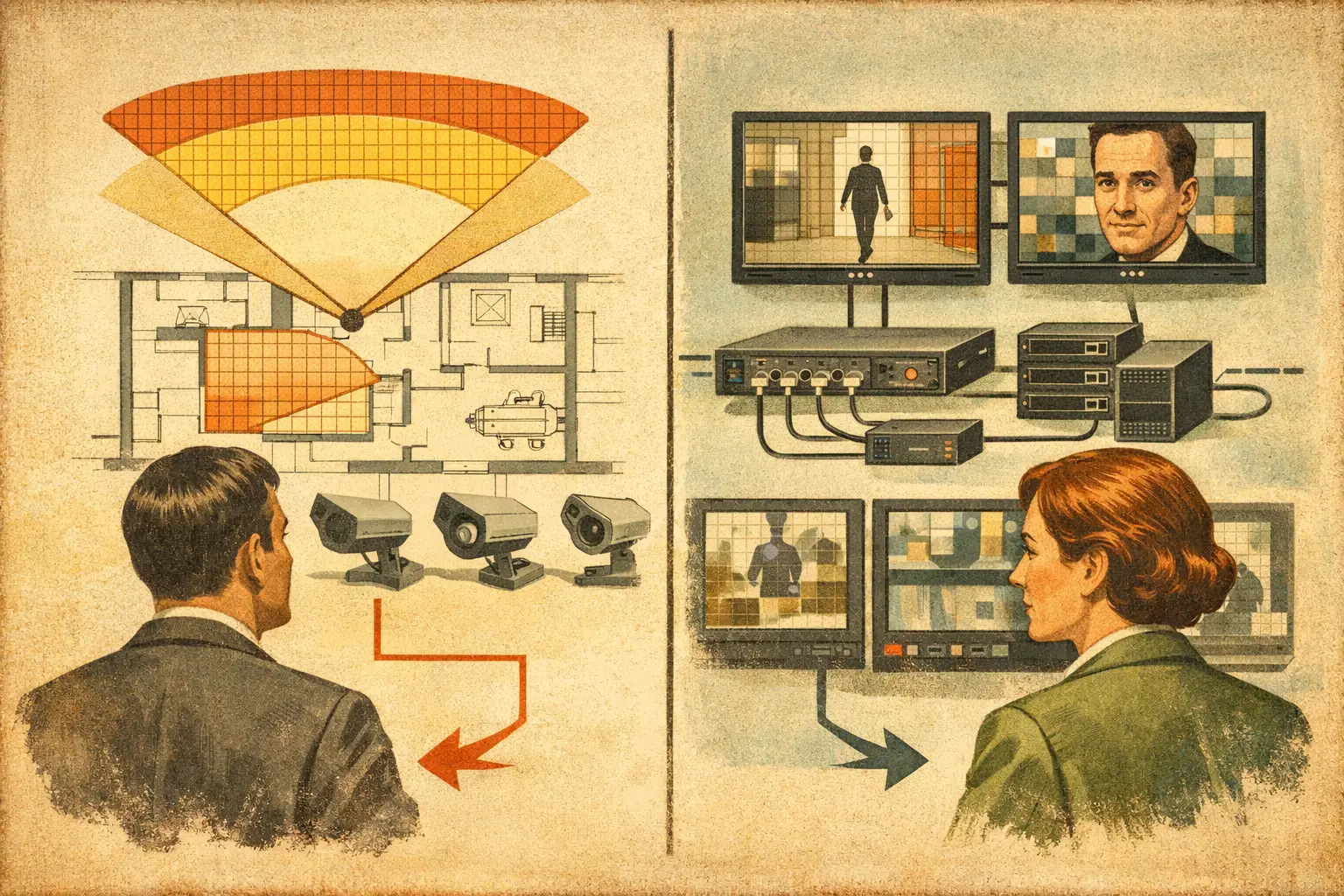
A camera cone on a floor plan can look convincing while still failing the operational objective. That is why DORI versus PPM is not a choice between two competing CCTV calculations. It is a design question: what level of usable image detail is required at a specific location, and can the proposed camera deliver it after field of view, focal length, sensor size, mounting height, tilt, and obstructions are considered?
For security consultants, installers, and reviewers, both measures have value. The risk arises when a general DORI distance from a datasheet is treated as proof that a camera will identify a person at every point in a corridor, gate, lobby, or perimeter line. A disciplined design uses pixel density to test the geometry of the actual scene, then documents the intended DORI outcome in terms that project stakeholders can understand.
What PPM Measures in a CCTV Design
PPM means pixels per meter. It expresses the number of horizontal image pixels available across one meter of scene width at a defined distance or plane. The basic calculation is:
PPM = horizontal image resolution / scene width in meters
If a camera produces 3840 horizontal pixels and its field of view is 15 meters wide at a doorway, the density at that plane is 256 PPM. If the same camera views a 30-meter-wide loading yard at a greater distance, density falls to 128 PPM. The camera has not changed. The scene geometry has.
This is why PPM is particularly useful on calibrated drawings. It turns a broad field of view into measurable coverage zones. A designer can evaluate where a selected density begins and ends, assess whether a doorway or lane sits inside that zone, and see where wide-angle coverage becomes too low for the stated task.
PPM is transparent because its inputs can be reviewed. Horizontal resolution, focal length, sensor size, target distance, and field width can be checked against the camera specification and the drawing scale. It also makes trade-offs visible. A shorter focal length covers more area but reduces density at range. A longer focal length increases density but narrows coverage and may introduce blind spots between cameras.
PPM alone does not state whether an image is operationally useful. It does not account for motion blur, poor focus, compression, lighting, wide dynamic range behavior, scene contrast, or a person facing away from the camera. It is a geometric image-detail metric, not a promise of field performance.
What DORI Adds to the Conversation
DORI is shorthand for Detect, Observe, Recognize, and Identify. It describes escalating operational tasks rather than merely the number of pixels in an image.
Detecting means establishing that a person or object is present. Observing supports monitoring general activity and behavior. Recognizing supports distinguishing a known individual from others. Identifying requires enough detail to establish identity under the project’s defined conditions.
The DORI framework is widely associated with IEC 62676-4 and EN 62676-4 video surveillance guidance. It is commonly expressed through indicative pixel-density levels, often 25 PPM for detect, 62.5 PPM for observe, 125 PPM for recognize, and 250 PPM for identify. These figures are useful engineering references, but they should not be copied into a specification without checking the applicable edition, client brief, local requirements, and the project’s intended target criteria.
In practical terms, DORI provides the language of the security objective. PPM provides the measurable spatial basis for checking whether the drawing supports that objective. A project owner may say, “We need to identify people at the entrance.” The designer can translate that requirement into an appropriate target density at the entrance plane, then test the camera position, lens selection, and viewing angle against it.
DORI versus PPM: The Important Difference
The most useful distinction is simple: DORI describes the required level of observation, while PPM quantifies image density at a location.
A DORI label is meaningful only when its assumptions are clear. A manufacturer may publish a DORI distance for a camera-lens combination using a specified resolution, sensor format, target size, and calculation method. That figure can be a helpful starting point when comparing equipment. It is not a substitute for analyzing the installed geometry.
Consider a 4K camera with a published identify distance. If it is mounted high above a reception area, tilted steeply downward, and aimed across a wide lobby, its pixel density may meet the reference threshold at part of the floor. Yet the face angle, backlighting from glazing, or a decorative partition may reduce the practical value of the image. Conversely, a camera at a controlled entrance can produce a more useful identification view with fewer pixels if the capture point, lighting, walking direction, and target presentation are managed carefully.
This is why DORI and PPM should not be treated as interchangeable labels. DORI is the operational intent. PPM is one of the most traceable calculations used to validate that intent during design.
Start With the Required Task, Not the Camera Resolution
A common design error is to begin with a camera model or megapixel count. Resolution matters, but it does not define the requirement. Start by assigning the required task to each critical area.
For a parking perimeter, detection or observation may be appropriate over a broad area, while a vehicle entrance may require recognition of drivers or clearer capture of vehicle activity. At a public entrance, identification may be required at a designated capture zone, not necessarily across the entire lobby. In a long corridor, the task may vary from observation over the general path to recognition at a cross-corridor door.
Once the task is stated, define the target plane. A target plane might be a doorway threshold, a turnstile line, a pedestrian route, a service counter, or a perimeter fence line. Calculating a single distance from the camera is rarely enough because usable density changes across the scene.
Then select initial camera parameters. Resolution, sensor size, focal length, mounting height, direction, and tilt should be considered together. A high-resolution camera with an unsuitable lens can be less effective than a lower-resolution camera placed to control scene width and target direction.
Review PPM Across the Actual Field of View
A calibrated floor plan allows density to be reviewed where the requirement exists, rather than at an arbitrary maximum range. Check the field of view at the target plane and review the PPM contour or coverage boundary around it.
Physical geometry matters just as much. Walls, columns, shelving, glazing, gates, and doors can create occlusion. A camera may mathematically cover a target zone while an obstruction blocks the view from the selected mounting point. Openings must also be represented correctly: treating a glass partition or doorway as a solid wall can produce an overly conservative result, while ignoring a wall creates false coverage.
Mounting height and tilt deserve close review. Higher mounting can improve resistance to tampering and broaden situational awareness, but it can reduce facial detail and create unfavorable vertical angles. Excessive tilt can also distort the relationship between image pixels and the floor-plane target. Where identification is required, a dedicated camera at a controlled capture point is often more defensible than expecting an overview camera to perform every task.
Document the Design So It Can Be Reviewed
A professional deliverable should show more than camera icons and cones. It should record the intended DORI purpose for each critical zone, the required PPM threshold, the camera parameters used in the calculation, and the resulting coverage area. It should also show assumptions that affect interpretation, such as drawing scale calibration, mounting height, lens setting, and whether the scene includes known obstructions.
This traceability helps different teams review the same decision. The security consultant can confirm operational intent. The installer can understand position and orientation. The ICT team can coordinate network topology and camera count. The project owner can see why a narrow identification view is required alongside broader overview coverage.
CCTV Design Tool Online supports this workflow by combining calibrated drawings, physical geometry, camera configuration, field-of-view visualization, DORI and pixel-density analysis, and structured reporting in one design workspace. The calculations remain design guidance. Final installation performance should be verified through commissioning, scene testing, and review by qualified professionals against the project requirements.
When a Published DORI Distance Is Enough, and When It Is Not
A published DORI distance can be adequate for early feasibility work, broad equipment comparison, or a preliminary budget concept. It helps answer whether a proposed camera family is broadly suitable for a short entrance view, a medium-distance corridor, or a long perimeter scene.
It is not enough for detailed design when the project depends on specific target locations, dense physical geometry, overlapping camera views, narrow passages, or client acceptance criteria. In those cases, use the published value as an input, not the conclusion. Review the actual field width at the target, calculate density, test obstructions, and consider lighting and target direction.
The same approach applies to overlap. Two camera fields of view may overlap visually while neither provides the required PPM at the critical point. Conversely, a small overlap can be valuable when it preserves observation continuity while a dedicated camera provides recognition or identification at a controlled point.
A useful CCTV design does not declare a camera “DORI compliant” in the abstract. It states what the camera is intended to achieve, where it is expected to achieve it, and which assumptions must hold for that result to remain credible.